The TP53 gene: the elephant’s secret to
cancer prevention?
Elephants are one of the largest land mammals on our planet and are well known for their grandeur in the
animal kingdom. But did you know that studying them can reveal insights into cancer prevention strategies? The secret behind this: a gene called TP53.
What is cancer?
All animals are made up of cells, the building blocks of life, which divide and grow. When this happens, their genetic material (DNA) gets replicated. But each cycle of division brings the risks of small changes to the DNA called mutations, which can cause cells to divide uncontrollably and therefore, cancer. In small animals, less division is needed for the animals to grow compared to large ones. Therefore, you’d expect larger animals with bigger mass, such as elephants, to experience more cell division cycles, mutations and a greater risk of cancer (1).
Peto’s Paradox
Interestingly, the natural world has shown that this is not always the case. Some larger animals with a greater number of cells actually have a reduced risk of cancer than smaller animals, an observation described as Peto’s Paradox (2). Indeed, elephants have been found to live for 60+ years (3) and have a lower risk of getting cancer than humans (their cancer mortality rate is 4.81% whereas this is between 11-25% in humans (1)).
TP53 in elephants
Genes are DNA sequences that contain a set of biological instructions and code for proteins. There are some genes animals harbour to help with cancer prevention. One
example is the TP53 gene. Humans possess just one copy of the TP53 gene, whereas elephants have 20 copies (4, 5). The gene codes for a protein called p53 which is tumour suppressor, literally meaning that is suppresses cancer and tumour development (6). When p53 is produced, it
identifies cells with DNA damage, and potentially
cancerous mutations, and destroys these cells to reduce the risk of cancer developing (1). Because of the higher TP53 copy number in elephants, experiments have shown that this chain of events is more prevalent in elephant cells than human cells (1).
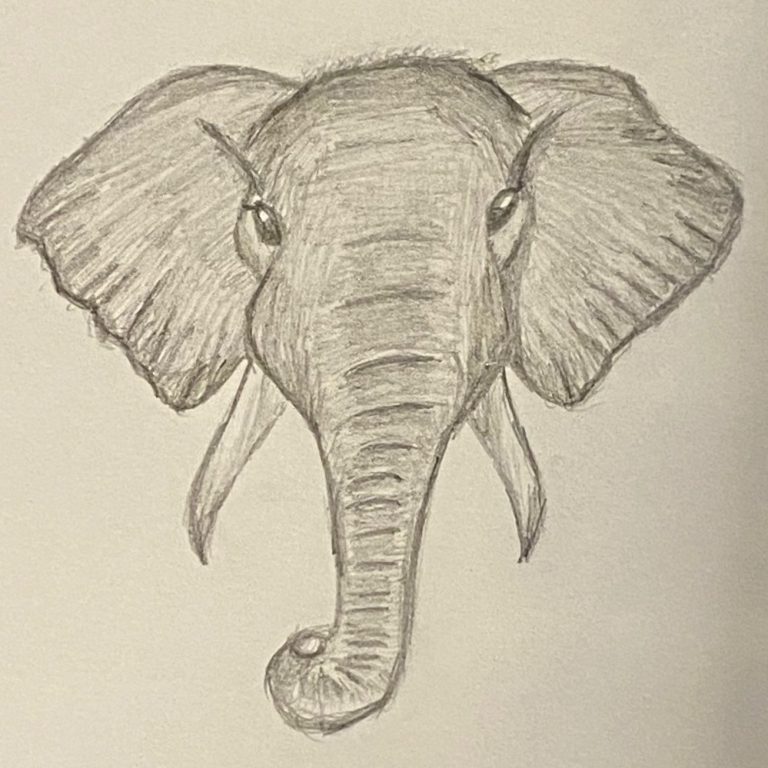
Sketch of an African elephant
TP53 in reproduction
However, more recent studies have hypothesized that the multiple TP53 copies in elephants may also be linked to reproduction. As elephants are mammals, their sperm are very sensitive to high temperatures and having these copies can help protect the viability of their sperm in the testes, where temperatures can reach over 37°C (4).
Cancer prevention in other long-lived animals
Research into long-lived mammals has also been extended to Greenland whales, which can live up to a
whopping 200 years. When their cells undergo DNA damage, they generate high levels of the DNA damage
repair protein called ERCC1, indicating that it has a role in cancer prevention (7). Interestingly, such research has also spread to reptiles such as the Galapagos tortoise, which have multiple copies of tumour suppressor genes for cancer protection, allowing them to live for 100+ years (8, 9, 10).
Conclusion
Long living animals have specific genes and proteins that are thought to play a role in cancer prevention, with TP53 being a highly studied example. However, most studies on cancer analysis in animals have been from already deceased individuals from zoos, therefore, the data on cancer prevalence may be different to those in the wild (10).
In human cancers, mutations in the TP53 gene are very common (11); the cancer overrides the destruction of DNA-damaged cells, further multiplying the cancer cells. Therefore, understanding the molecular
mechanisms and properties of the TP53 gene and p53 protein in animal cancer prevention could provide greater insights into cancer therapies and anticancer drugs in humans.
References
- Abegglen, L.M., Caulin, A.F., Chan, A., Lee, K., Robinson, R., Campbell, M.S., Kiso, W.K., Schmitt, D.L., Waddell, P.J., Bhaskara, S., Jensen, S.T., Maley, C.C. and Schiffman, J.D. (2015) Potential Mechanisms for Cancer Resistance in Elephants and Comparative Cellular Response to DNA Damage in Humans. Journal of the American Medical Association. [Online] 314(17), p.1850. https://doi.org/10.1001/jama.2015.13134
- Uzoigwe, C.E. (2025). Peto’s paradox: 2 problems 2 answers. Frontiers in Ecology and Evolution. [Online] 13. https://doi.org/10.3389/fevo.2025.1489294
- Lee, P.C., Fishlock, V., Webber, C.E. and Moss, C.J. (2016). The reproductive advantages of a long life: longevity and senescence in wild female African elephants. Behavioral Ecology and Sociobiology, 70(3), pp.337–345. https://doi.org/10.1007/s00265-015-2051-5
- Vollrath, F. (2023). Uncoupling elephant TP53 and cancer. Trends in Ecology and Evolution, 38(8), pp.705–707. https://doi.org/10.1016/j.tree.2023.05.011
- Voskarides, K. and Giannopoulou, N. (2023). The Role of TP53 in Adaptation and Evolution. Cells, [online] 12(3), p.512. https://doi.org/10.3390/cells12030512
- Wang, W., Liu, X., Liu, H., Abolhassani, H., Yan, H., Zhang, H. and Wang, X. (2026). p53: from understanding its structure to advances in therapeutic targeting. Signal Transduction and Targeted Therapy. [Online] 11(1). https://doi.org/10.1038/s41392-025-02549-5
- Gazzellone, A., & Sangiorgi, E. (2024). From Churchill to Elephants: The Role of Protective Genes against Cancer. Genes. [Online] 15(1), 118. https://doi.org/10.3390/genes15010118
- Quesada, V., Freitas-Rodríguez, S., Miller, J. et al. Giant tortoise genomes provide insights into longevity and age-related disease. Nature Ecology and Evolution. [Online] 3, 87–95 (2019). https://doi.org/10.1038/s41559-018-0733-x
- Scott Glaberman, Stephanie E Bulls, Juan Manuel Vazquez, Ylenia Chiari, Vincent J Lynch, Concurrent Evolution of Antiaging Gene Duplications and Cellular Phenotypes in Long-Lived Turtles, Genome Biology and Evolution, Volume 13, Issue 12, December 2021, evab244, https://doi.org/10.1093/gbe/evab244
- Scott Glaberman, Stephanie E Bulls, Laura Platner, Philipp Wagner, Saskia Dreyer, Stephanie McCain, Silvia Burgstaller, Leyla R Davis, Heléna Turner, Linda G R Bruins-van Sonsbeek, Dominik Fischer, Ylenia Chiari, Do turtles get cancer?, BioScience, Volume 75, Issue 9, September 2025, Pages 699–705, https://doi.org/10.1093/biosci/biaf100
- Robles, A.I., Jen, J. and Harris, C.C. (2016). Clinical Outcomes of TP53 Mutations in Cancers. Cold Spring Harbor Perspectives in Medicine. [Online] 6(9), p.a026294. https://doi.org/10.1101/cshperspect.a026294