
Exhibitions
In Bloom: Exploring the Beauty of Botany at the Ashmolean
Earlier this year, I took the opportunity to visit the Ashmolean's highly rated In Bloom exhibition. I've always loved botanical artwork, but this experience was much more than beautiful paintings.
We're taken on a journey into the origins of botany and how plants became key characters of trade, medicine and art. The exhibition showcases the archives of influential collectors whose work helped shape our understanding and the importance of plants today.
Some notable collectors whose work was featured in the exhibition include John Tradescant the Older and Younger, a father and son who were gardeners of the royal families in the 16th and 17th century. Their botanical
collections obtained from travels abroad, including rare species, were some of the first at the time and would
advance people’s understanding of the natural world (1).
It was also wonderful to see the contributions of females in this field including Elizabeth Blackwell, an enthusiastic artist whose work later developed into her famous 'A Curious Herbal' publication. Initially, the incentive behind this book was to raise funds for her husband who was severely in debt. Later, this book became a valuable resource for health professionals, using the various volumes to better understand the medicinal qualities of plants (2).
Another female who is certainly worth mentioning is Maria Sybilla Merian, an ambitious entomologist
(a person that studies insects). She defied society in the 17th century by not only divorcing her husband, but
travelled to South America in pursuit of a greater
understanding of metamorphosis and documented these through her beautiful art (3). Like caterpillars transform into butterflies, Maria transformed expectations and chose to chase her curiosities.
The influential role of plants in history was also highlighted by “Tulipomania”, the 17th century Dutch event where rare tulips with striking stripes, and their bulbs, became highly prized and fiercely sought after. These dramatic streaks were later discovered to be caused by the tulip breaking virus, aptly named for the way it “breaks” a tulip’s solid colour into vivid flames and stripes (4). Artists of the time frequently painted these
extraordinary blooms, transforming them into a recognisable category of Dutch art, beautiful examples of which also appear in the exhibition. They also happen to be my favourite type of tulip and today they flourish across tulip farms throughout the UK in the Spring.
There's also mention of how plants became a source of medicine, a famous example being opium as a painkiller drug, extracted from the opium poppy plant (5). Across
different cultures, this has become an important medicinal plant, the properties of which have shaped both traditional remedies and later pharmaceutical developments. Around the same time, as Britain was expanding its trade networks, rare and exotic plants became desirable in British gardens, later infiltrating fashion.
Of course, the seamless transport of tropical species across different countries and indeed climates became a battle in itself (and was also a question that concerned me though the exhibit). However, the exhibition had an answer to this: the Wardian Case, an airtight container made from word and glass, which preserved plants during transportation. This is a great example of how our understanding of plants drove new inventions and technologies, allowing us to
further pursue curiosities of the wider world.
Today, our knowledge of plants is vast and continues to
expand as we observe the natural world. However, the
exhibition warns us that 45% of flowering plants today at risk of extinction, a reminder of the need to protect them and avoid their overexploitation as we confront climate change.
Items featured in the exhibition:
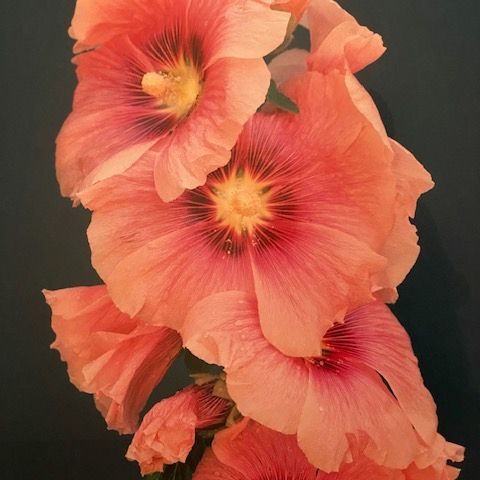
Hollyhock by Kate Friend
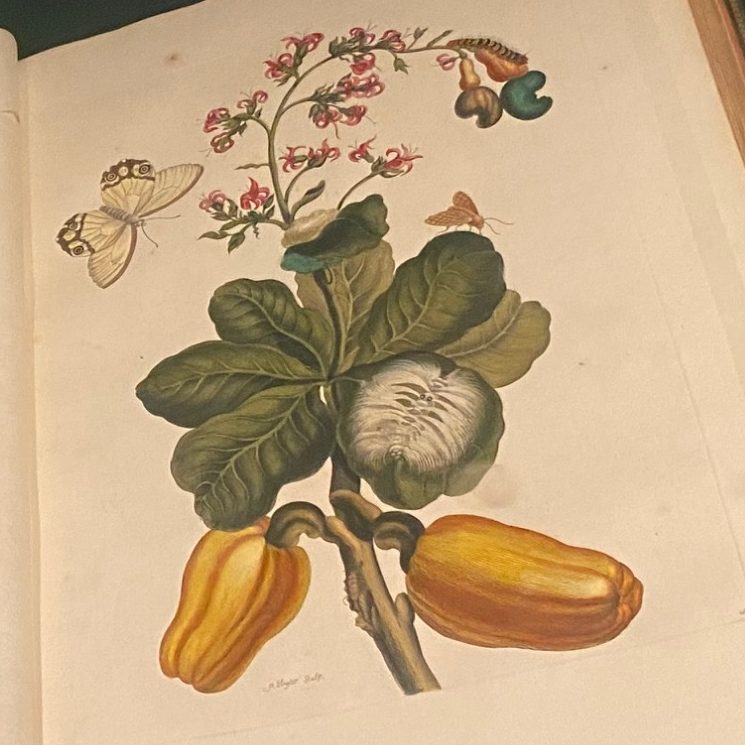
Painting of a Cashew Plant and Amber Phantom Butterfly from Maria Sybilla Merian's "Metamorphosis insectorum Surinamensium" publication.
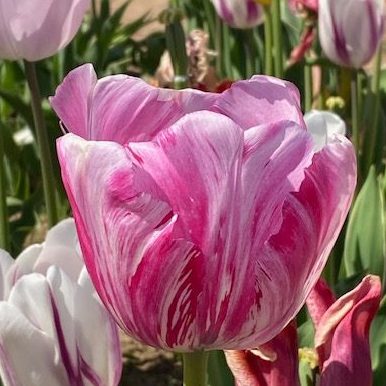
A “Sorbet' tulip with its distinctive pink and white stripes, captured by at Tulley’s Tulip Farm in Warwickshire.
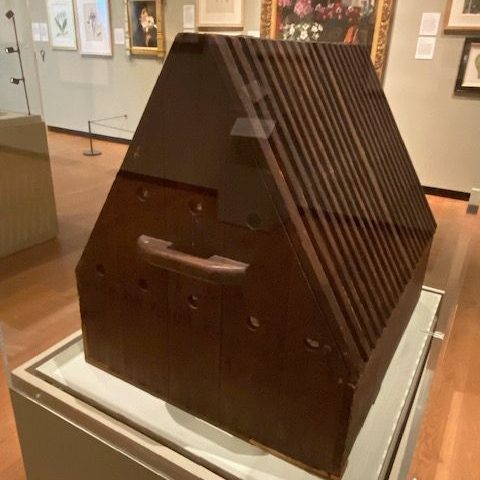
A Wardian Case dating from ~1870 displayed at the exhibition
References:
1) University of Oxford, Ashmolean Museum (2013) The Collectors: Tradescants. Available at: https://britisharchaeology.ashmus.ox.ac.uk/collections/tradescant.html (Accessed: 24 July 2026).
2) Monroe, N. (2026) Elizabeth Blackwell’s Curious Herbal. Available at: https://www.rhs.org.uk/education-learning/libraries-at-rhs/articles/elizabeth-blackwell (Accessed: 24 July 2026).
3) Lotzof, K (2021) Maria Sibylla Merian: Metamorphosis unmasked by art and science. Available at: https://www.nhm.ac.uk/discover/maria-sibylla-merian-metamorphosis-art-and-science.html (Accessed: 24 July 2026).
4) Wong, A.A., Carrero, G. and Hillen, T. (2025). How the tulip breaking virus creates striped tulips. Communications Biology. [Online] 8(1). doi:10.1038/s42003-025-07507-z.
5) Cambridge University Botanic Garden (2026) Opium Poppy (Papaver somniferum). Available at: https://www.botanic.cam.ac.uk/learning/trails/medicines/opium-poppy-papaver-somniferum/ (Accessed: 24 July 2026).